
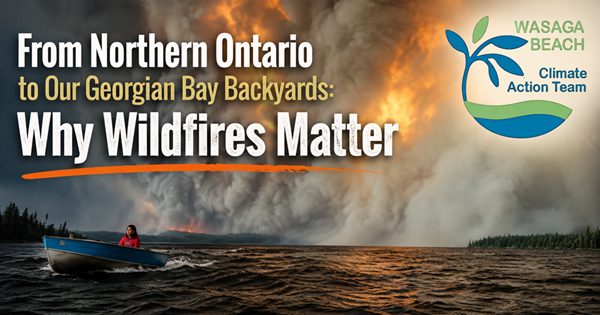
From Northern Ontario to Our Georgian Bay Backyards:
Why Wildfires Matter
Could Wildfires Become Canada’s Biggest Climate Challenge?
Wildfires have become one of Canada’s most visible and destructive consequences of climate change.
As of mid-July 2026, Canada has experienced more than 3,100 wildfires, with approximately 800 active fires still burning across the country, including about 60 fires that remain out of control. More than 1.4 million hectares of forest have already burned this year, and northern Ontario is currently experiencing one of its worst wildfire seasons in recent history, with over 100 active fires affecting communities and creating hazardous smoke conditions and unhealthy air quality alerts in our Georgian Bay region, across Ontario and much of eastern North America. This smoke may even cross the Atlantic Ocean to reach western Europe as it already did last couple of years.
Toronto Air Quality Index (AQI) and Air Quality health Index (AQHI) were the worst for a big city in the world on July 15, 2026, worse that new Delhi or Beijing!
While wildfires are a natural part of Canada’s boreal forest ecosystem, climate change is making them larger, more frequent, and much harder to control. Rising average temperatures, prolonged droughts, earlier snowmelt, and more frequent heat waves leave forests drier for longer periods. Lightning storms, another major cause of wildfires, are also expected to increase as the climate warms. Scientists agree that climate change has significantly increased the likelihood of the extreme wildfire seasons Canada has experienced in recent years.
Unfortunately, the relationship between wildfires and climate change works both ways. As forests burn, they release enormous amounts of carbon dioxide (CO₂), methane, and other greenhouse gases that have been stored in trees, vegetation, and soils for decades or even centuries. Smoke from wildfires also contains black carbon (soot), which can settle on Arctic snow and ice, causing it to absorb more sunlight and melt faster. This creates a dangerous feedback loop: climate change fuels more wildfires, and wildfires, in turn, accelerate climate change through increased greenhouse gas emissions. During Canada’s record-breaking 2023 wildfire season alone, wildfire emissions reached levels comparable to several years of Canada’s total fossil fuel emissions.
The impacts extend far beyond the forests. Wildfire smoke has become one of Canada’s largest seasonal air pollution hazards, increasing the risk of asthma, heart disease, stroke, and other respiratory illnesses. Entire communities have been evacuated, wildlife habitat has been destroyed, and billions of dollars are spent each year on emergency response, firefighting, and rebuilding damaged infrastructure.
Although wildfires cannot be eliminated entirely, their severity can be reduced. Cutting greenhouse gas emissions remains the most important long-term solution. Governments can also invest in better forest management, including prescribed burns, fuel reduction, and improved wildfire detection and response systems. Communities can reduce their risk by creating FireSmart properties, maintaining defensible space around homes, and avoiding activities that can accidentally start fires during dry conditions.
Wildfires are no longer just a summer inconvenience—they are becoming one of the defining environmental challenges of our time. Addressing climate change today is essential to protecting Canada’s forests, wildlife, communities, and the clean air we all depend on for generations to come.
Engage with Wasaga Beach Climate Action Team
Wasagabeachclimateaction.com [email protected]
Disclaimer
·This Blog was first published in What’s Up? Georgian Bay, August 2026 edition (See Page 4)

Photo in poster, Courtesy of Bryan Davies Photography.